Ready To Breed Your Dog?
Here is what you need to know and do to be ready to have a litter
From understanding the stages of pregnancy and whelping, through to setting up your home to host puppies, here is a detail overview to ensure you are well informed in what to expect and what to get ready.
Gestation Overview, Pregnancy Confirmation and Predicting Whelping
Canine gestation (pregnancy) is approximately 63 days from ovulation. There is no accurate blood test for pregnancy in dogs, as there is in humans, as the hormones involved stay elevated for this entire duration, whether a bitch is pregnant or not. To confirm a positive pregnancy, an abdominal ultrasound is recommended 28 days from ovulation. During this ultrasound, the puppies are assessed for size and movement. The number of puppies a bitch is carrying may be determined, and the length of gestation can be estimated.
Some bitches may experience inappetence and nausea during pregnancy. It is recommended to offer them their usual complete and balanced diet for the first six weeks, and transition to a high quality puppy food for the final 3 weeks of gestation. This ensures adequate stores of calcium for giving birth and for lactation. If the diet is deficient in calcium, which home cooks and mainly meat based diets often are, a potentially life threatening condition called hypocalcaemia (AKA milk fever or eclampsia) can develop. A common fallacy of supplementing the bitch with oral calcium syrup during birth or in the couple of days following doesn’t actually help prevent this condition due to the complex medical pathways of calcium absorption from the intestine, and the utilisation of calcium from bones.
The best way to determine the day a bitch is going to give birth is to measure the blood progesterone levels prior to mating to determine ovulation timing. This is because the sperm can survive in the reproductive tract for several days and some bitches may allow mating outside the ovulation window, therefore predicting whelping dates using mating dates only, gives a window of 57 – 73 days. Toward the end of pregnancy, progesterone levels fall rapidly, a blood test may be recommended at this time. Depending on the method of expected delivery, a progesterone test and ultrasound may be used in combination to assess foetal development and viability to assist in decision making.
How To Prepare For A Litter
A whelping area should be prepared prior to the due date, ideally around week 8 of gestation to allow the bitch time to become familiar with the area. This should be in a warm, low traffic area inside away from other pets and kids, or in a kennel environment away from weather elements and other animals.
If planning a natural whelping at home, the area should be set up and equipment organised ready for birthing. Things that you should have prepared should include:
- Whelping box of appropriate size
- Contact information of your vet in case of needed assistance or emergency
- Vet beds (special machine washable moisture-wicking blanket bedding) and puppy pads (large absorbent and disposable pads) to line the whelping box
- Towels to wipe and stimulate puppies after birth
- Puppy umbilical clamps or dental floss to tie off umbilical cords that are susceptible to bleeding
- Hot water bottle (with cover to protect from burns) or covered heating pad
- Kitchen scales and notebook / pen for recording puppy weights and other important data such as whelping time commencement / puppy birth times etc
- Miscellaneous items such as: basket muzzle (in case the bitch has a history of attempting to eat puppies or vigorous chewing of chords), coloured velcro puppy collars or other identification items
A whelping box is a bassinet of the puppy world, and is used to create a safe environment for the puppies to be born and used in their first few weeks of life. Commercial whelping boxes are available, however there are a range of box alternatives you can use. Your whelping box should consist of an area that is easily cleaned and large enough for the mother to comfortably lie down flat on her side. It should have side walls to limit the puppies within a small area that can be kept clean and warm, but not be too high that the bitch cannot step over to get in and out for eating / drinking, toileting etc. Bare in mind that a bitch will have significant mammary development when feeding puppies and this delicate tissue will decrease her ground clearance when standing. Do not place any bowls inside the whelping box as this can create contamination risks or become drowning risks.
An ambient temperature of 30 degrees should be maintained for the first week. Heat pads or hot water bottles can be used for give warm spots that the puppies can move closer to or further away from as needed for thermoregulation. It is imperative that all heated surfaces be insulated with thick bedding / covers to prevent burns, and that all heating aids are positioned in such a way that puppies cannot become trapped behind them.
As the puppies develop, they’ll be better able to move themselves around to regulate their own body temperature, at this time the ambient temperaturfe can be reduced to 26 – 27 degrees.
Stages Of Labour
The first stage of labour can last between 6 – 12hrs, and is triggered by a cascade of hormones, including the drop in progesterone (<6nmol/L), which together causes the start of uterine contractions and cervical dilation. This stage is characterised by panting, trembling and nesting behaviours such as scratching at bedding and sitting up and down. It is also common for some dogs to experience vomiting and hypersalivation during this stage. They may also ask to go to the toilet often, and may pass loose stools.
During the second stage of labour, cervical dilation combined with strong uterine and abdominal contractions allow the passing of the puppies and placentas through the birth canal. During this stage the bitch can be seen actively bearing down during the abdominal contractions as well as licking at the vulva. It is normal at this stage to see a lot of clear fluid and some blood tinged fluid with the presentation of the first puppy. The placentas in dogs are green, so green discharge prior to the birth of the first puppy can be a sign of an emergency.
The third stage of labour occurs once all puppies and placentas have been expelled and the uterus is contracting and involuting (returning to it’s normal state). It is normal for some puppies to be born without their placentas, and for the placentas to be passed together during the third stage. The bitch will stop having strong abdominal contractions and the amount of discharge will lessen. Some discharge is normal for up to 6 weeks post whelping.
Birthing Puppies
Dogs usually lick amniotic sack off the face of the puppies as they are born to stimulate them, but inexperienced bitches may take too long to do this, and need assistance to help break the membranes and allow the puppy to breathe. Similarly, bitches often chew the umbilical cords instinctively, and ingest the placentas, but this should be closely monitored as some bitches are too vigorous and cause umbilical hernias or worse. Ingestion of several placentas can sometimes lead to vomiting.
Upon the birth of each puppy, the following should be done:
- Stimulate the puppy with a dry towel by running back and forth on the body, until it is making a noise / crying and the tongue is pink (a blue tinge to the mouth / tongue initially at time of delivery is normal)
- If the puppy is struggling, place head on a downward angle to allow gravity to drain any mucous from the mouth and nose whilst rubbing the puppy along it’s back and sides. Gentle wiping of the face whilst the head is downwards, helps to remove mucous over the mouth and nose so air can freely move in and out of the nose and mouth. Do NOT swing puppies to force fluids out of the airway, we now know that this old technique sometimes included in older publications, can lead to intracranial bleeding.
- Check the umbilicus for bleeding. Apply an umbilical clamp or tie off the cord 1-2cm away from the body wall if bleeding occurs
- Once the puppy is crying, place the puppy onto a nipple to suckle
- Continue to monitor puppy placement as they may become detached or stuck under the bitch when delivering the next puppy
- Check for the presence of any abnormalities including abnormal limbs, cleft palates, lack of rectum or anything else that appears unusual or missing. Any abnormalities should be presented to your veterinarian withing 24hrs of birth
- Keep a record of when each puppy is born to keep track of time between puppies and birth order
Once all puppies have been born and the bitch has entered the third stage of labour, record the weight, sex and colour ID of each puppy. Coloured velcro collars can be used to distinguish each puppy from it’s litter mates. The puppies should be toileted using a cotton ball soaked in lukewarm water to stimulate the genitals for toileting, if the bitch isn’t toileting them.
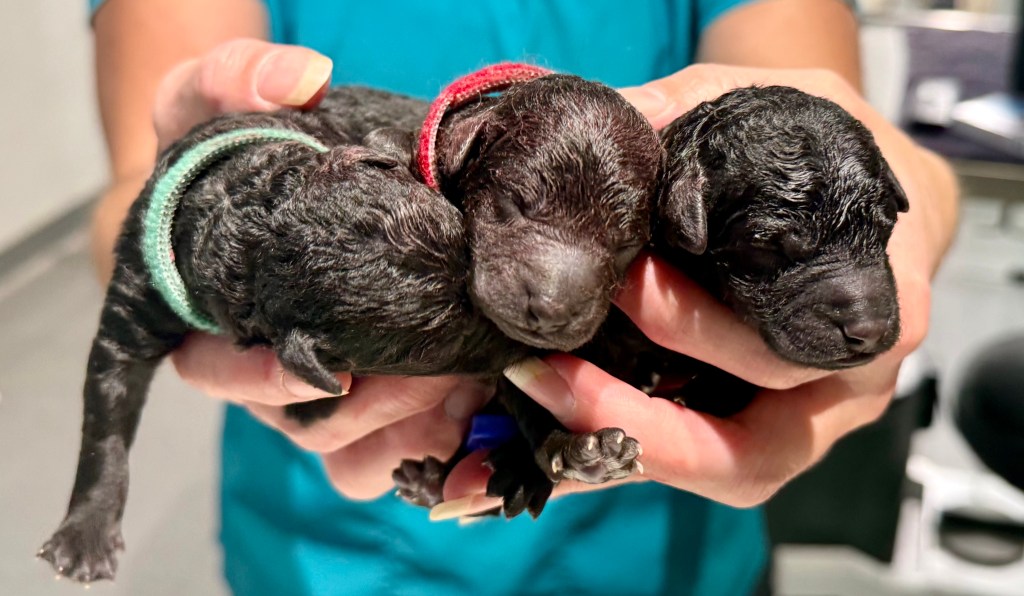
The bitch should be closely monitored for the next 24hrs to assess maternal instincts with mothering and caring for the puppies. Things to watch for include:
- Is the bitch toileting the puppies correctly and regularly? Watch for any over vigorous cleaning or chewing
- Is the bitch allowing the puppies to attach to nipples and feed for an appropriate amount of time?
- Watch to ensure the bitch is not gnawing at the umbilicus leading to bleeding
- Is the bitch prone to laying on the puppies?
- Is the bitch avoiding nursing the puppies? You may need to sit by her side to encourage her to lay and rest allowing the puppies adequate time to suckle
- Monitor the bitch for any aggressive behaviour toward the puppies. Some bitches require a basket muzzle to prevent injuring puppies or you may need to speak to your vet about medications to help her to relax
- Puppies should have their growth monitored closely on a daily basis to ensure no failure to thrive is observed. It is recommended to weigh puppies twice a week for the first week and weekly thereafter all going well. Their behaviour and development should also be monitored. Any weak or absent suckling, lethargy, not seeking out nipples or weight loss / failure to gain weight should be considered an emergency and veterinary support sought swiftly
When To Call For Help
It is best to have a good relationship with your vet, in case of reproductive emergencies. You should also be familiar with the location of your nearest ER in case of our of hour emergencies.
During the second stage of labour, it is important to be aware of the types of complications that can occur and be familiar enough with them to recognise when something is going wrong. Swift intervention is essential for the survival of the pups and even the bitch in some circumstances.
If any of the following occurs, a vet should be contacted immediately:
- Coloured discharge rather than clear fluid from the vulva. You should be concerned about green, black or frank blood (bright red) prior to the birth of a puppy
- More than 2hrs has passed between stage 2 labour and the production of a pup
- A lethargic or inattentive bitch
- If the mother appears to be in excessive pain or becomes abnormally aggressive
- If more than 20 minutes of strong abdominal contractions (pushing / bearing down) has occurred without the complete birth of a puppy
- If a puppy is only partially delivered for more than a few pushes or seems stuck in the birth canal for more than 20 minutes
In cases where veterinarian attention is required for dystocia (failure or prolonged delivery of puppy/puppies), or other complications have occurred, the following diagnostic tests and procedures can be expected:
- Ultrasound and / or radiographs of the abdomen to determine presence of remaining puppies
- Ultrasound to determine viability of remaining unborn puppies
- Vaginal examination to palpate if a puppy is stuck in the birth canal
- Bloodwork to determine risk of haemorrhage, infection or low blood calcium
- Progesterone test if labour is not progressing
- Intravenous fluid therapy for hydration
- Medical management of labour
- Surgical intervention (caesarean) to remove remaining puppies
Which tests or procedures are performed depends on the complication, stage of labour, puppy viability and number of puppies in utero at the time of presentation.