What is progesterone testing and why does this matter?
From ovulation prediction to impending labour, progesterone is a hormone that can tell us quite a bit about your breeding bitch.
In this arcticle we will explain when we use this test, why and how it can be advantageous for you in breeding.
What is progesterone?
Progesterone is a reproductive hormone produced by the ovaries during the heat cycle in a female dog. The levels of progesterone produced, change between the stages of the oestrus cycle, allowing the transition between the four stage: proestrus > oestrus > dioestrus > anoestrus to be monitored. Dogs are unique as a species in that progesterone remains elevated in dioestrus, whether a bitch gets pregnant or not, which is why it cannot be used to confirm pregnancy.
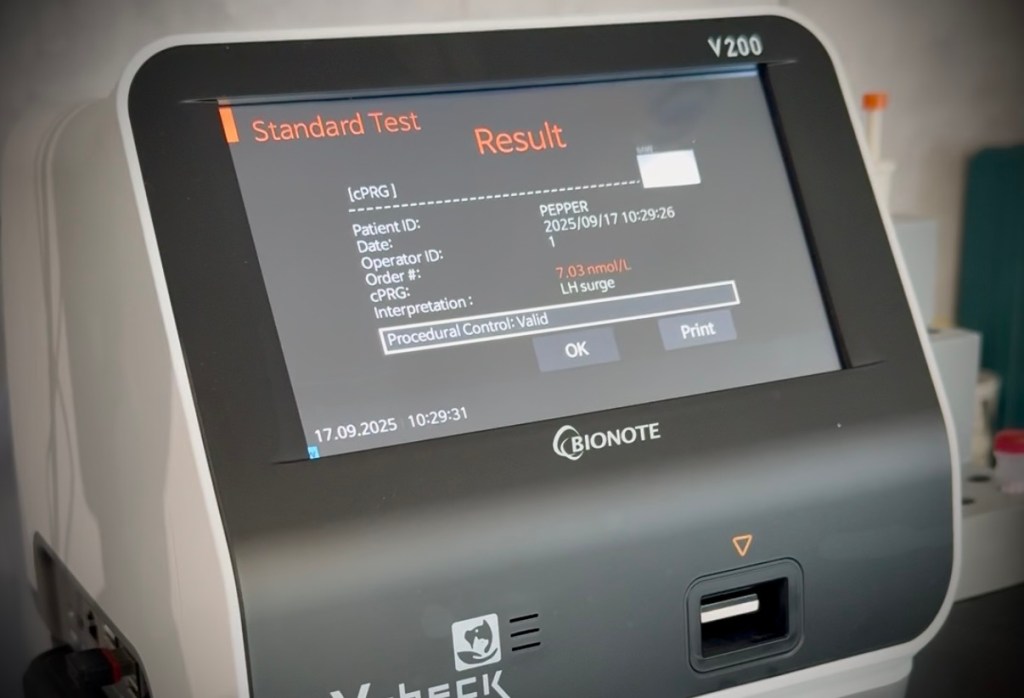
For optimal breeding to occur, the timing of ovulation is important, as dogs release immature eggs from their ovaries that take between 2 to 3 days to mature and become fertile. Whilst luteinising hormone, or LH, is responsible for ovulation, or releasing the eggs from the ovary, we do not currently test specifically for this due to complexities in test timing, which is why progesterone is used instead to predict the LH surge and therefore timing of ovulation. This blood test can be performed using our in-house analyser with a very quick turn-a-round time, or it can be sent to an external laboratory if preferred.
Why do we do progesterone testing?
In breeding bitches, there are many benefits to monitoring this hormone, including:
- Tracking progesterone will optimise breeding dates for your bitch depending on your chosen breeding method (i.e. natural vs artificial insemination) to give increased litter success. Once the LH surge is established, we can give you a prediction of ovulation and due date
- Using the predictive due dates based on ovulation, allows better planning for pregnancy management and labour
- Predictive ovulation timing prior to mating is also used in assessing the safe timing of caesareans and can allow us to perform safe elective caesareans within normal clinic hours under controlled conditions
- Progesterone testing can be used to assess impending labour, with levels dropping rapidly towards the end of pregnancy, assisting in timing of caesarean
- Progesterone testing can also be used to assist in the investigation of reproductive disorders such as split or silent heats, delayed reproductive maturity or hypoluteoidism
When to start testing?
It is recommended that all testing is done with the same machine throughout the oestrus cycle and ideally tests are conducted at a similar or preferably the exact same time of day, on a fasted blood sample.
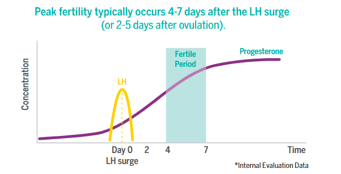
Although results are given as a numerical value, there is no specific level we use associated with the LH (Lutenizing Hormone) surge due to this testing not being preferred. Repeated progesterone measurements are used to determine the sudden increase, or ‘peak’ that occurs 48hrs prior to ovulation. Ovulation is the confirmed with the continual exponential increase of progesterone which ensures that an effective cycle and release of eggs has occurred. This predicts the fertile period which occurs 2 to 3 days post ovulation, when the oocytes (eggs) are mature and ready for fertilisation, given the breeding window.
There can be a lot of variation between bitches, especially if they are young and have not had many oestrus cycles. In general, progesterone testing should commence around day 5 of oestrous and repeated ongoing based on the previous results until ovulation is confirmed. Progesterone testing is often used in conjunction with vaginal cytology, to give a complete reproductive assessment, and vaginal cytology can be used to guide when to start progesterone testing.
Using the initial progesterone data collected prior to breeding a whelping date can be predicted as 63 days (+/- 2 days) post ovulation. This can be confirmed with testing conducted at 60 days into gestation to monitor for a sudden drop in progesterone, indicating impending labour (within 24hrs). This is vital information in assessing bitches that may be experiencing whelping complications, as well as used for determining optimal timing for an elective caesarean.